Come far leggere Google Docs ad alta voce: 4 metodi che funzionano davvero
Vuoi sentire tu stesso queste voci?
Prova subito gratuitamente il nostro Assistente vocale AI. Non è richiesta la registrazione.
Punti chiave:
• Google Docs non ha un pulsante nativo per la lettura ad alta voce, ma puoi usare il TTS integrato di Chrome, i lettori schermo o le estensioni.
• La lettura ad alta voce di Chrome è gratuita ma suona robotica e non ha un'opzione di download.
• I lettori schermo come ChromeVox sono progettati per l'accessibilità, non per un ascolto occasionale.
• AI Narrator è la soluzione migliore: 32 voci IA naturali, oltre 50 lingue, download WAV e profonda integrazione con Google Docs.
• Tutti i metodi funzionano su Windows, Mac e Chromebook. Il supporto mobile varia in base allo strumento.
Molti utenti confondono la funzione di digitazione vocale di Google Docs con la sintesi vocale. Sono funzioni opposte. La digitazione vocale (che si trova in Strumenti > Digitazione vocale) ascolta la tua voce e digita ciò che dici: è un sistema di riconoscimento vocale. La sintesi vocale fa il contrario: legge il tuo testo scritto ad alta voce. Se stavi cercando come usare la sintesi vocale su Google Docs e hai trovato accidentalmente la digitazione vocale, non sei il solo. Le due funzioni sono nello stesso menu ma servono a scopi completamente diversi.
Google ha dato priorità alla compatibilità con i lettori schermo rispetto a una funzione casuale di "Lettura ad alta voce". Il loro approccio consiste nel far funzionare Google Docs con software di lettura schermo dedicati piuttosto che integrare il TTS nell'editor stesso. Questo funziona bene per gli utenti con esigenze di accessibilità che hanno già installato lettori schermo, ma lascia gli utenti occasionali senza un modo ovvio per ascoltare i loro documenti. La buona notizia è che le soluzioni esistono: basta sapere dove cercare.
Passaggio 1: Apri il tuo Google Doc
Vai su docs.google.com e apri il documento che vuoi far leggere ad alta voce. Assicurati di utilizzare il browser Chrome: questa funzione non funziona in Firefox, Safari o Edge.
Passaggio 2: Abilita la lettura ad alta voce nelle impostazioni di Chrome
Clicca sul menu a tre punti in Chrome (angolo in alto a destra) e vai in Impostazioni > Accessibilità. Attiva "Leggi ad alta voce il testo selezionato" se non è già abilitato. Nelle versioni più recenti di Chrome, potresti anche vedere un'opzione "Leggi ad alta voce" direttamente nel menu contestuale del tasto destro.
Passaggio 3: Fai clic destro e seleziona Leggi ad alta voce
Posiziona il cursore dove vuoi che inizi la lettura, quindi fai clic destro in un punto qualsiasi del documento. Seleziona "Leggi ad alta voce" dal menu contestuale. Chrome inizierà a leggere da quel punto usando la voce predefinita del sistema.
Passaggio 4: Controlla la riproduzione
Una piccola barra degli strumenti di riproduzione appare nella parte superiore della pagina con i pulsanti play/pausa, paragrafo precedente e paragrafo successivo. Puoi anche regolare la velocità di lettura e la voce in Impostazioni Chrome > Accessibilità > Gestisci voci.
Nessuna installazione richiesta
Funziona immediatamente in Chrome senza estensioni o componenti aggiuntiviCompletamente gratuito
Nessun costo, nessun livello premium, nessun limite di utilizzoControlli di riproduzione di base
Riproduci, metti in pausa, salta avanti e indietro tra i paragrafiRegolazione della velocità
Rallenta o accelera il ritmo di lettura nelle impostazioni
Qualità della voce robotica
Utilizza la voce TTS predefinita del tuo sistema, che suona meccanica e manca di intonazione naturaleOpzioni vocali limitate
Solo 2-3 voci disponibili a seconda del sistema operativoNessun download audio
Non è possibile salvare l'audio come file per l'ascolto offline o la condivisioneNessuna varietà linguistica
Limitato alle voci installate sul tuo sistema, solitamente solo inglese
Il TTS integrato di Chrome è ideale quando hai bisogno di un modo rapido e senza fronzoli per ascoltare un breve documento. È ottimo per gli utenti con esigenze di accessibilità che hanno già configurato lettori schermo sul proprio sistema. Funziona bene per una rapida correzione di bozze di alcuni paragrafi. Ma per documenti più lunghi, audio di qualità professionale o contenuti multilingue, vorrai esplorare gli altri metodi in questa guida.
ChromeVox è il lettore schermo di Google, integrato in ChromeOS e disponibile come estensione di Chrome. È progettato specificamente per le app di Google Workspace e offre la massima integrazione con Google Docs. ChromeVox legge tutto sullo schermo: menu, barre degli strumenti e contenuto del documento, e supporta scorciatoie da tastiera per la navigazione. È la migliore opzione di lettore schermo per Google Docs su un Chromebook.
NVDA (NonVisual Desktop Access) è un lettore schermo gratuito e open source per Windows. È uno dei lettori schermo più popolari al mondo e funziona bene con Google Docs in Chrome. NVDA legge il contenuto del documento, la formattazione e gli elementi di navigazione. Puoi scaricarlo da nvaccess.org e configurarlo per Google Docs nelle sue impostazioni.
VoiceOver è il lettore schermo integrato di Apple, disponibile su Mac, iPhone e iPad. Su Mac, abilitalo in Impostazioni di Sistema > Accessibilità > VoiceOver. VoiceOver si integra con Google Docs in Safari e Chrome, leggendo il contenuto del documento e fornendo scorciatoie di navigazione. Su iOS, VoiceOver funziona con l'app mobile Google Docs per l'ascolto in movimento.
TalkBack è il lettore schermo di Google per Android. Funziona con l'app Android di Google Docs, permettendoti di ascoltare i documenti sul tuo telefono o tablet. Abilitalo in Impostazioni > Accessibilità > TalkBack. Tocca due volte per attivare gli elementi e usa i gesti di scorrimento per navigare nel documento.
Navigazione completa del documento
Naviga per titolo, paragrafo, parola o carattere con scorciatoie da tastieraPiattaforma nativa
Integrato nel tuo sistema operativo senza bisogno di software aggiuntivo (eccetto NVDA su Windows)Standard di accessibilità
L'approccio standard del settore per gli utenti con disabilità visive
Curva di apprendimento ripida
Gli screen reader utilizzano scorciatoie da tastiera complesse e richiedono tempo per essere padroneggiatiQualità della voce robotica
Le voci predefinite suonano meccaniche e mancano della fluidità naturale della narrazione IANon progettato per un ascolto occasionale
Gli screen reader leggono tutto ciò che c'è sullo schermo, inclusi menu e barre degli strumenti, non solo il documentoNessuna esportazione audio
Impossibile scaricare l'audio come file per la condivisione o l'uso offline
La maggior parte delle estensioni di lettura ad alta voce segue lo stesso schema di base: le installi dal Chrome Web Store, aggiungono un'icona alla barra degli strumenti di Chrome e quando fai clic sull'icona mentre sei su un documento Google, iniziano a leggere la pagina. Le estensioni migliori sanno distinguere tra il contenuto del documento e gli elementi dell'interfaccia di Google Docs, leggendo solo il testo che hai effettivamente scritto. Alcune ti consentono di selezionare un testo specifico da leggere, mentre altre elaborano l'intero documento.
Installazione facile
Installazione con un clic dal Chrome Web Store, nessuna configurazione necessariaMigliore qualità vocale
Molte estensioni offrono voci migliorate rispetto alla sintesi vocale integrata di ChromeSelezione del testo
La maggior parte ti consente di selezionare un testo specifico da leggere, piuttosto che l'intera paginaSupporto multilingue
Supporto per oltre 50 lingue in molte estensioni
Livelli gratuiti limitati
Molte estensioni popolari limitano l'uso gratuito a pochi minuti al giornoIntegrazione generica
La maggior parte è progettata per le pagine web, non specificamente per Google DocsNessun download audio
La maggior parte delle estensioni gratuite non ti consente di salvare l'audio come fileProblemi di privacy
Alcune estensioni inviano il testo del documento a server esterni per l'elaborazione
Perché AI Narrator? È l'unico strumento che combina voci IA naturali, profonda integrazione con Google Docs, supporto multilingue e download di file audio, tutto in un'unica estensione. Che tu stia correggendo bozze, creando contenuti audio o rendendo accessibili i documenti, AI Narrator gestisce tutto.
32 voci IA naturali
Voci professionali che suonano umane — non robotiche o monotoneOltre 50 lingue
Supporto per inglese, spagnolo, francese, hindi, cinese, arabo e molte altreFunziona all'interno di Google Docs
Una barra laterale nativa che vive dentro il tuo editor di documenti, senza bisogno di cambiare schedaDownload di file audio
Esporta la tua narrazione come file WAV per l'ascolto offline, podcast o presentazioni
Leggi il testo selezionato
Evidenzia un paragrafo o una sezione e AI Narrator leggerà solo quella selezioneControllo della velocità
Regola la velocità di riproduzione da 0,5x a 2x per adattarla alle tue preferenze di ascoltoAnalisi dei documenti IA
Elaborazione intelligente che rispetta intestazioni, paragrafi e struttura del documentoGratuito per iniziare
Inizia a usare AI Narrator gratuitamente senza bisogno di carta di credito
Passo 1: Installa AI Narrator dal Chrome Web Store
Vai sul Chrome Web Store e cerca "AI Narrator" o visita direttamente la pagina dell'estensione. Fai clic su "Aggiungi a Chrome" e conferma l'installazione. L'estensione richiede circa 10 secondi per l'installazione e aggiunge un'icona alla tua barra degli strumenti di Chrome.
Passo 2: Apri il tuo documento Google
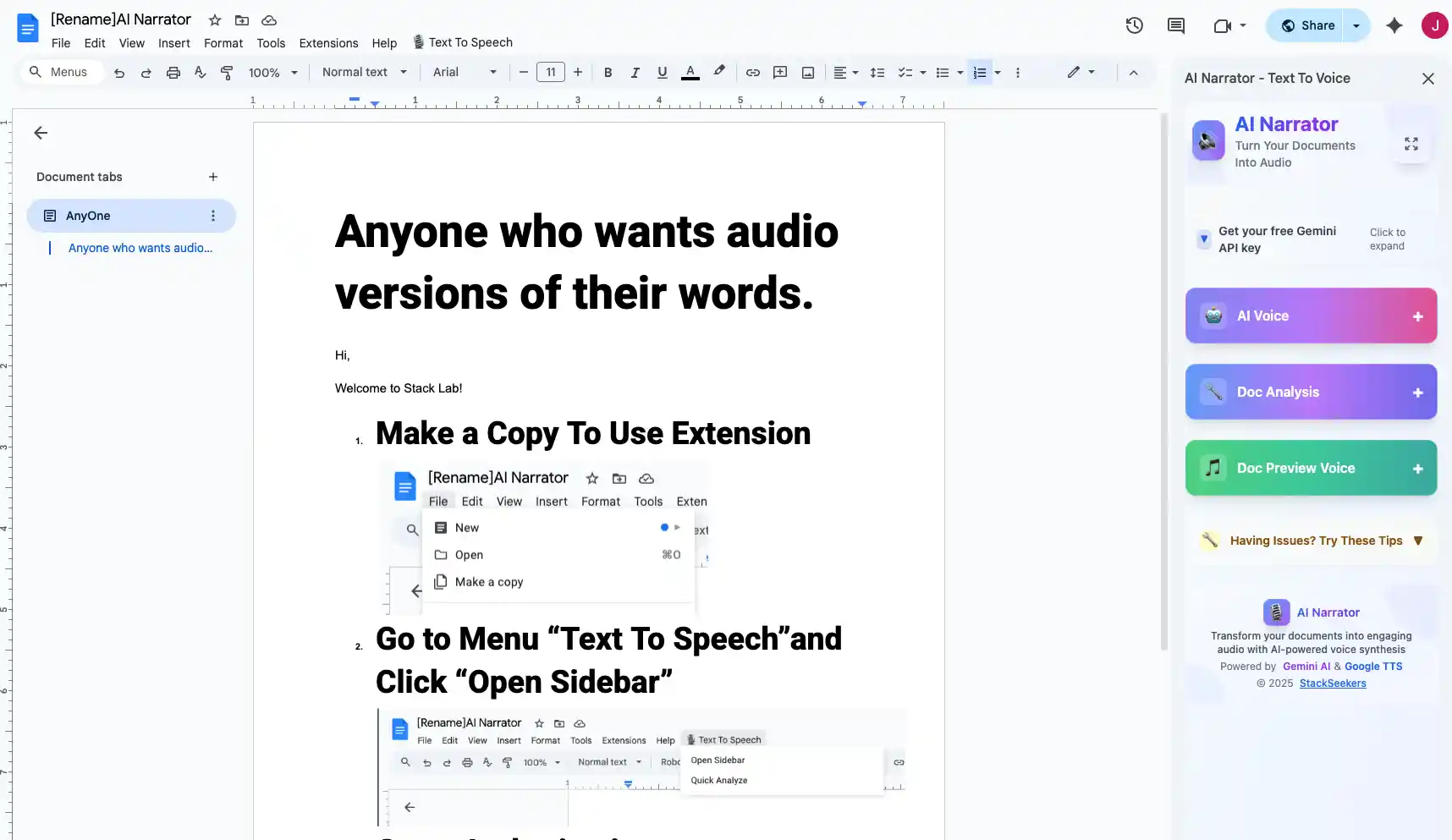
Vai su docs.google.com e apri qualsiasi documento. Puoi anche aprire Google Docs da Google Drive. La barra laterale di AI Narrator apparirà automaticamente sul lato destro dell'editor.
Passo 3: Avvia la barra laterale di AI Narrator
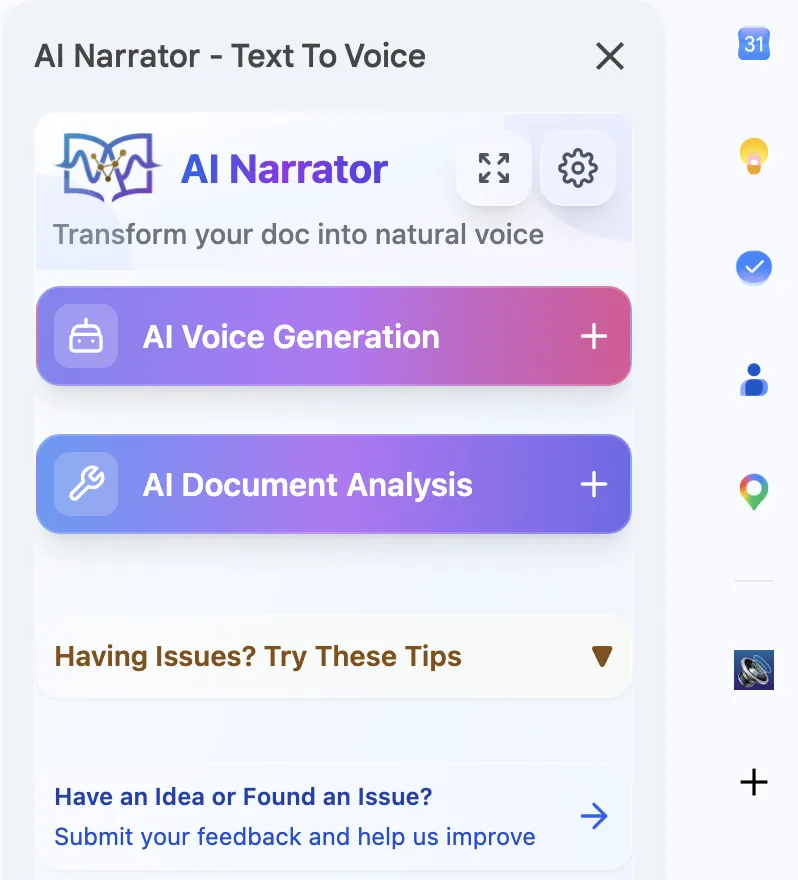
Se la barra laterale non appare automaticamente, fai clic sull'icona di AI Narrator nella barra degli strumenti di Chrome o trovala sotto Estensioni nel menu di Google Docs. La barra laterale si apre con un'interfaccia pulita e intuitiva che mostra le opzioni vocali, i controlli di riproduzione e le impostazioni.
Passo 4: Scegli la tua voce
Sfoglia le 32 voci IA disponibili. Puoi filtrare per lingua, accento o stile. Fai clic sul pulsante di anteprima accanto a qualsiasi voce per ascoltare un campione. Le scelte popolari includono Emma (inglese americano), Sophie (inglese britannico) e Lucas (inglese australiano).
Passo 5: Seleziona il testo o l'intero documento
Evidenzia il testo specifico che vuoi leggere ad alta voce, o lascia tutto deselezionato per far leggere a AI Narrator l'intero documento. L'estensione gestisce in modo intelligente entrambe le modalità, saltando intestazioni, piè di pagina ed elementi di formattazione.
Passo 6: Genera e ascolta
Fai clic sul pulsante "Genera". AI Narrator elabora il testo e inizia la riproduzione in pochi secondi. Usa i controlli di riproduzione per mettere in pausa, saltare o regolare la velocità. L'audio viene riprodotto attraverso gli altoparlanti o le cuffie con intonazione e ritmo naturali.
Passo 7: Scarica l'audio
Fai clic sul pulsante di download per salvare la narrazione come file WAV. Il file è pronto per essere utilizzato in presentazioni, podcast, video YouTube o qualsiasi altro progetto. Puoi anche condividerlo direttamente con colleghi o studenti.
Trasforma note di lezione, guide di studio e capitoli di libri di testo in file audio che puoi ascoltare durante gli spostamenti, l'esercizio fisico o le faccende domestiche. La ricerca mostra che combinare la lettura con l'ascolto migliora la ritenzione fino al 40%. Uno studente che prepara gli esami può generare audio dalle sue note Google Doc e ascoltarlo durante il jogging mattutino.
Il tuo orecchio cattura errori che l'occhio perde. Frasi goffe, parole mancanti, frasi ripetute ed errori di battitura diventano evidenti quando li senti pronunciare ad alta voce. Molti editor professionisti usano la sintesi vocale come fase finale di correzione prima della pubblicazione. Le voci naturali di AI Narrator rendono questo processo confortevole anche per i documenti lunghi.
Riadatta post di blog, newsletter e articoli in episodi di podcast o narrazioni per YouTube. Le 32 voci di AI Narrator ti consentono di abbinare il tono dei tuoi contenuti — professionale per contenuti aziendali, caloroso e colloquiale per blog personali, energico per materiale promozionale. Scarica il file WAV e importalo nel tuo software di editing.
Gli insegnanti possono creare versioni audio di fogli di lavoro, compiti di lettura e materiali di studio. Ciò è particolarmente prezioso per gli studenti con dislessia, disabilità visive o difficoltà di apprendimento. Le voci naturali di AI Narrator riducono l'affaticamento durante l'ascolto rispetto alle voci robotiche degli screen reader, rendendo più facile per gli studenti rimanere coinvolti durante le lunghe sessioni di ascolto.
Ascolta rapporti, proposte e note di riunioni durante il tragitto o in viaggio. Un rapporto di 20 pagine che richiede 45 minuti per essere letto può essere ascoltato in 20 minuti a velocità 2x. Il controllo della velocità di AI Narrator ti consente di trovare il ritmo perfetto per diversi tipi di contenuti — più lento per rapporti finanziari complessi, più veloce per aggiornamenti semplici.
AI Narrator supporta oltre 50 lingue con voci dal suono nativo. Uno studente di spagnolo può far leggere il suo Google Doc ad alta voce in spagnolo castigliano. Uno studente di giapponese può ascoltare una pronuncia giapponese naturale. Questo è inestimabile per i corsi di lingua, il lavoro di traduzione e la comunicazione internazionale.
Per gli utenti con disabilità visive, dislessia o difficoltà di lettura, AI Narrator offre un'alternativa agli screen reader tradizionali. Le voci IA naturali sono più facili da ascoltare per periodi prolungati e l'interfaccia semplice non richiede l'apprendimento di scorciatoie da tastiera complesse. È utile anche per gli utenti con lesioni da sforzo ripetitivo che devono far riposare gli occhi.
Studio
Trasforma le note in audio per imparare durante gli spostamenti o l'esercizioCorrezione di bozze
Cattura errori all'orecchio che perdi leggendo in silenzioPodcast
Converti i contenuti scritti in audio per gli episodi dei podcastNarrazione YouTube
Genera voci fuori campo per i video dalle tue sceneggiature scritte
| Funzionalità | Integrato in Chrome | Estensione leggi ad alta voce | Screen reader | Narratore AI |
|---|---|---|---|---|
| Qualità vocale | Robotico | Discreto | Robotico | AI naturale |
| Numero di voci | 2-3 | 5-10 | 2-3 | 32 |
| Lingue | Voci di sistema | 10-50 | Voci di sistema | 50+ |
| Scarica audio | No | Limitato | No | Yes (WAV) |
| Controllo velocità | Basic | Sì | Variabile | 0.5x-2x |
| Integrazione Google Docs | Browser overlay | Toolbar button | Full support | Native sidebar |
| Selezione testo | Full page | Sì | Sì | Sì |
| Ideale per | Quick checks | Casual listening | Accessibilità | Everything |
| Cost | Gratuito | Free / Paid | Gratuito | Free / Premium |
Chrome Read Aloud on Windows
Open Google Docs in Chrome. Right-click anywhere in the document and select "Read aloud." Chrome reads from your cursor position using the system's default voice. Adjust speed in Chrome Settings > Accessibility.
AI Narrator on Windows
Install AI Narrator from the Chrome Web Store. Open any Google Doc and the sidebar appears automatically. Choose from 32 voices, adjust speed, and click Generate. Download your audio as a WAV file.
NVDA Screen Reader on Windows
Download NVDA from nvaccess.org. Install and run it. Open Google Docs in Chrome and enable screen reader support under Tools > Accessibility. NVDA reads your document using keyboard shortcuts. Press NVDA + Down Arrow to start reading.
Chrome Read Aloud on Mac
Open Google Docs in Chrome. Right-click and select "Read aloud." For the best results, make sure you've enabled the Read Aloud feature in Chrome Settings > Accessibility first.
AI Narrator on Mac
Install AI Narrator from the Chrome Web Store. The extension works identically on Mac as on Windows. Open your Google Doc, select a voice from the 32 available options, and click Generate.
VoiceOver on Mac
Enable VoiceOver in System Settings > Accessibility > VoiceOver. Open Google Docs in Chrome or Safari. VoiceOver reads your document and provides navigation shortcuts. Press VO + A to read all, or VO + Right Arrow to move through elements.
ChromeVox on Chromebook
Press Ctrl + Alt + Z to enable ChromeVox. Open Google Docs and ChromeVox reads the page. Use the ChromeVox cursor (Search + Arrow keys) to navigate. Press Search + Right Arrow to move forward through text.
AI Narrator on Chromebook
Install AI Narrator from the Chrome Web Store. It works the same way as on any other platform. The sidebar opens in your Google Doc and you can choose from 32 voices, adjust speed, and download audio.
TalkBack Screen Reader
Enable TalkBack in Settings > Accessibility > TalkBack. Open the Google Docs app and navigate to your document. TalkBack reads the content as you swipe through it. Use two-finger gestures to scroll and double-tap to interact with elements.
Google TTS Engine
Install Google Text-to-Speech from the Play Store. Go to Settings > System > Languages & input > Text-to-speech output and select Google TTS as the engine. Some apps, including Google Docs, will use this engine when accessibility features are enabled.
AI Narrator on Mobile Browser
Open Google Docs in Chrome on your Android phone. Install AI Narrator and access it through the Chrome extension menu. While the mobile experience is not as seamless as desktop, AI Narrator still provides natural voice playback and audio downloads.
Speak Screen on iOS
Enable Speak Screen in Settings > Accessibility > Spoken Content. In the Google Docs app, swipe down from the top of the screen with two fingers. iOS reads the entire screen aloud. You can adjust speaking rate and voice in the Spoken Content settings.
VoiceOver on iOS
Enable VoiceOver in Settings > Accessibility > VoiceOver. Open Google Docs and use VoiceOver gestures to navigate your document. Swipe right to move forward through text, or use the rotor (two-finger旋转 gesture) to navigate by heading or paragraph.
AI Narrator via Chrome on iOS
Open Google Docs in Chrome on your iPhone or iPad. While the full AI Narrator experience is optimized for desktop, you can access basic TTS features through the Chrome browser on iOS. For the best mobile experience, use your desktop to generate audio files and transfer them to your device.
Check that your system volume is turned up and not muted. Make sure you're not using Bluetooth headphones that are connected to a different device. In Chrome, check that the Read Aloud feature is enabled in Settings > Accessibility. If using AI Narrator, ensure the playback volume slider in the sidebar isn't set to zero. Try playing audio from another website to confirm your speakers or headphones are working.
Chrome's Read Aloud sometimes struggles with Google Docs because the document is rendered as a complex canvas element rather than plain HTML. Try selecting all text (Ctrl + A) before right-clicking. If that doesn't work, try refreshing the page and trying again. Some Google Docs extensions conflict with Read Aloud — try disabling other extensions temporarily.
If AI Narrator doesn't appear in your Google Docs toolbar, check that it's enabled in Chrome's extension settings. Go to chrome://extensions and make sure AI Narrator is toggled on. Try refreshing your Google Doc. If the sidebar still doesn't appear, click the Extensions icon (puzzle piece) in Chrome's toolbar and look for AI Narrator in the list.
Some extensions require specific permissions to work with Google Docs. When you install AI Narrator, Chrome will ask for permission to "Read and change your data on docs.google.com." This is necessary for the extension to access your document content. If you denied this permission during installation, go to chrome://extensions, find AI Narrator, click "Details," and update the site permissions.
Text-to-speech features can be affected by Chrome updates, conflicting extensions, or cached data. If something stops working, try these steps: update Chrome to the latest version (chrome://settings/help), clear your browser cache, disable other extensions one by one to find conflicts, or try opening Google Docs in an incognito window. If the problem persists, uninstall and reinstall the AI Narrator extension.
Mobile browsers have more restricted access to TTS APIs. Chrome on Android doesn't support the same Read Aloud features as desktop Chrome. The Google Docs mobile app has limited TTS support compared to the web version. For the full experience on mobile, use a desktop browser to generate audio files, then transfer them to your phone for offline listening.
| Strumento | Free Plan | AI Voices | Lingue | Audio Download | Ideale per |
|---|---|---|---|---|---|
| Narratore AI | Sì | 32 natural AI | 50+ | WAV | Everything |
| Chrome Read Aloud | Sì | System TTS | Voci di sistema | No | Quick checks |
| Estensione leggi ad alta voce | Sì | Google TTS | 50+ | No | Casual listening |
| NaturalReader | Limited (20 min/day) | Premium AI | 20+ | MP3 (paid) | Professional use |
| Speechify | Limited (few min) | Premium AI | 30+ | MP3 (paid) | Web articles |
| ChromeVox | Sì | System TTS | Voci di sistema | No | Accessibilità |
Yes, Google Docs can read to you, but not through a built-in button. You can use Chrome's Read Aloud feature (right-click > Read aloud), screen readers like ChromeVox or VoiceOver, or install a text-to-speech extension like AI Narrator for natural AI voices.
Google Docs doesn't have a native text-to-speech button, but it supports text-to-speech through Chrome's accessibility features, screen reader compatibility, and third-party Chrome extensions. The most popular option is AI Narrator, which adds a full TTS panel directly inside Google Docs.
There's no "Read Aloud" button inside Google Docs itself. To use Chrome's Read Aloud, right-click anywhere in your Google Doc and select "Read aloud" from the context menu. If you don't see this option, enable it in Chrome Settings > Accessibility.
Google Docs doesn't provide a built-in way to download audio. However, AI Narrator lets you export your narration as a WAV file. Other extensions like NaturalReader and Speechify offer MP3 downloads in their paid tiers.
AI Narrator offers 32 natural AI voices that sound human and engaging. It has more natural-sounding options than any other Google Docs TTS tool, including voices in 50+ languages. Speechify and NaturalReader also offer AI voices, but at higher prices and with more restrictions.
Yes, with some limitations. On Android, use TalkBack or Google's TTS engine. On iOS, use VoiceOver or Speak Screen. AI Narrator works through Chrome on mobile, though the experience is best on desktop. For the highest quality on mobile, generate audio on desktop and transfer the file.
Yes, AI Narrator has a free tier that lets you try all features. Premium plans unlock additional voices, unlimited conversions, and priority processing. You can start using AI Narrator for free with no credit card required.
AI Narrator is the best extension for Google Docs text-to-speech. It's the only extension designed specifically for Google Docs with a native sidebar, 32 AI voices, 50+ languages, and WAV audio downloads. Other extensions like Read Aloud work but lack the voice quality and Google Docs integration.
Chrome's built-in Read Aloud and screen readers work offline using your system's TTS engine. AI Narrator requires an internet connection for AI voice generation, but you can download audio files for offline listening. This makes it easy to create offline audio versions of your documents.
With Chrome's Read Aloud, highlight the text first, then right-click and select "Read aloud." AI Narrator automatically reads only the selected text when you highlight a section before clicking Generate. Screen readers like ChromeVox can read selected text using keyboard shortcuts.
Voice Typing (Tools > Voice typing) converts your spoken words into text — it's speech-to-text. Text-to-speech does the opposite: it reads your written text aloud. They serve completely different purposes. If you want Google Docs to read to you, you need text-to-speech, not Voice Typing.
Yes. Google Docs supports screen readers like ChromeVox, NVDA, VoiceOver, and TalkBack for accessibility. You can also enable screen reader support in Google Docs under Tools > Accessibility settings. For a more comfortable listening experience, AI Narrator's natural voices are easier on the ears during long sessions.
Pronto a provare l'Assistente vocale AI?
Inizia oggi stesso a convertire i tuoi documenti Google in audio professionale. Gratis per sempre!
Aggiungi al Doc - È gratis